 champignonmagique-quebec.com
Deadly Mushroom Lookalikes in Quebec You Must Avoid
Every fall, foragers across Quebec head into the boreal forest and mixed woodlands with baskets and high hopes. Some of them end up in emergency rooms. The province hosts several fatally toxic species that closely mimic edible or sought-after mushrooms, and the resemblance can fool experienced pickers, not just beginners.
Why Quebec's Forests Are Particularly Risky
Quebec's diverse ecosystems, spanning maple-beech forests in the south, spruce-fir stands in the north, and riparian zones everywhere in between, create ideal habitat for dozens of Amanita and Galerina species. Many of these grow alongside choice edibles like chanterelles, porcini, and meadow mushrooms. That proximity is exactly what makes the identification stakes so high.
Amatoxins, the primary lethal compounds in several Quebec species, are colorless, odorless, and heat-stable. Cooking does not destroy them. A single cap of Amanita phalloides can deliver a fatal dose to an adult.
The Most Dangerous Lookalikes
Death Cap - Amanita Phalloides
The death cap is responsible for the majority of fatal mushroom poisonings worldwide. In Quebec it has expanded its range over the past two decades, now appearing in southern regions around Montreal and the Eastern Townships, often growing near introduced European trees like oaks and linden.
Its cap ranges from pale yellow-green to olive-brown, 5–15 cm across. The gills are white, the stem has a skirt-like ring, and the base sits inside a white cup called a volva, often buried in soil. Foragers most commonly confuse it with the puffball (when young and egg-shaped), the paddy straw mushroom, and young meadow mushrooms. Symptoms appear 6–24 hours after ingestion: severe abdominal cramps, vomiting, and diarrhea.
A deceptive recovery period follows, then rapid liver and kidney failure begins around day three.
Destroying Angel - Amanita Bisporigera
Pure white from cap to base, Amanita bisporigera is native to Quebec and widespread in mixed and deciduous forests. It is the species most often confused with the button mushroom (Agaricus campestris) and with young oyster mushrooms.
The key distinction is the volva. Button mushrooms have no cup at the base and their gills turn pink, then chocolate-brown as they mature. The destroying angel's gills stay white at every stage. It contains the same amatoxins as the death cap and carries an equivalent fatality risk.
Children are especially vulnerable given their lower body mass.
Autumn Skullcap - Galerina Marginata
This small, honey-brown mushroom grows in clusters on decaying logs and woody debris across the province. It is frequently mistaken for two targets: the edible honey mushroom (Armillaria mellea) and, critically, psilocybin-containing Psilocybe species.
Galerina marginata contains amatoxins in concentrations high enough to cause liver failure from a small handful of caps. The error of confusing it with Psilocybe species is particularly dangerous because people consuming them are often in informal settings without fast access to medical care. Both genera can appear on the same rotting wood. Galerina has a rust-brown spore print; Psilocybe species typically show a purple-brown to dark violet-brown print.
That spore print check is non-negotiable.
False Morel - Gyromitra Esculenta
The false morel mimics the prized true morel (Morchella species) with a brain-like, irregularly lobed cap. True morels have a cap that is fully fused to the stem and completely hollow inside when cut lengthwise. The false morel's interior is chambered or cottony, and the attachment between cap and stem is partial.
Gyromitra esculenta contains gyromitrin, which metabolizes into monomethylhydrazine, a compound also found in rocket fuel. Toxicity varies with geography, season, and individual body chemistry. Some people tolerate small amounts; others experience hemolytic anemia, liver damage, and neurological symptoms from the same batch. In Quebec, false morels appear in spring on sandy soils near conifers, exactly where true morels also fruit.
Fool's Webcap - Cortinarius Rubellus
Cortinarius rubellus and its close relative C. orellanus cause orellanine poisoning, a particularly insidious form of toxicity because symptoms can be delayed 2–3 weeks after ingestion. By the time kidney failure becomes evident, the connection to mushroom consumption is easy to miss.
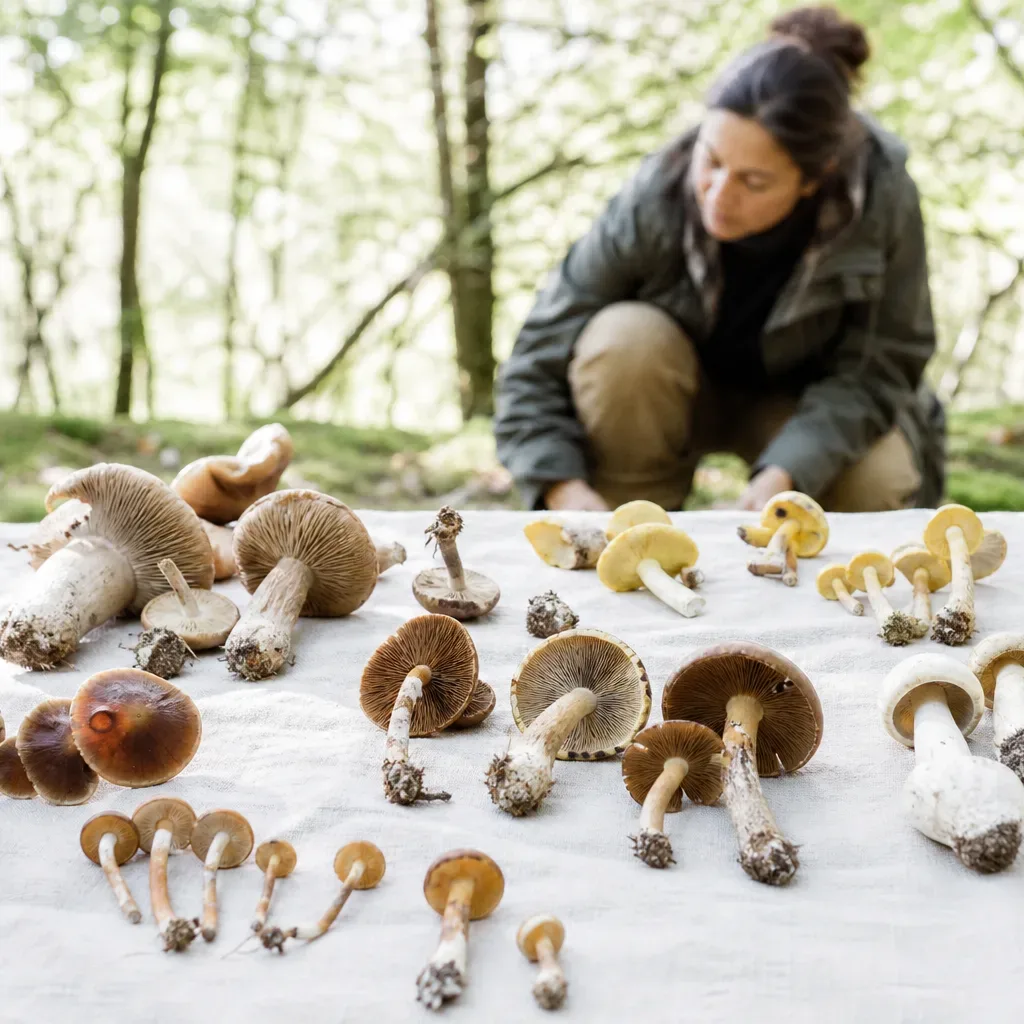
In Quebec's boreal and mixed forests, this cinnamon-to-rust-colored webcap grows with spruce and pine. It is sometimes gathered by people seeking chanterelles or by those targeting edible Cortinarius species, of which there are several. The distinguishing feature of toxic webcaps is the cobweb-like veil, called a cortina, connecting the cap edge to the stem in young specimens. Chanterelles have false gills, forked ridges that run down the stem; true gills are a warning sign.
How to Reduce Your Risk
Photos alone are not a safe identification method. Color, size, and shape shift with age, weather, and local soil conditions. Use a physical field guide specific to northeastern North America, such as David Arora's "Mushrooms Demystified" or Gary Lincoff's "National Audubon Society Field Guide to North American Mushrooms." Cross-reference at least three morphological features before eating anything.
The volva check is essential for any white or pale mushroom. Dig around the base carefully with your fingers to expose the full base of the stem. A cup-shaped sheath means Amanita: do not eat it regardless of what the cap looks like.
Take a spore print for every unfamiliar collection. Place the cap gill-side down on white paper for 4–6 hours. White spore prints from white-gilled mushrooms are a consistent warning sign for toxic Amanita species.
What to Do If You Suspect Poisoning
Call 911 or Quebec Poison Control at 1-800-463-5060 immediately if you or someone else has eaten a wild mushroom and feels unwell. Do not wait for symptoms to worsen. Bring the mushroom, or a photo of it, to the emergency department. Medical staff can contact mycologists through the poison control network for rapid identification support.
Amatoxin poisoning is not reversible once liver damage sets in. Speed of treatment is the single most important factor in survival.
Frequently Asked Questions
Which Is the Most Toxic Mushroom?
Amanita phalloides, the death cap, is considered the most toxic mushroom in the world. A single cap contains enough amatoxins to cause fatal liver and kidney failure in an adult. It has expanded into southern Quebec and is frequently mistaken for edible species like meadow mushrooms and puffballs.
Is Mushroom Picking Legal in Canada?
Personal foraging for mushrooms is generally legal in Canada, but rules vary by location. In Quebec's provincial parks, picking is typically restricted or prohibited. On Crown land and in national parks, quantity limits and permit requirements may apply. Always check with the specific land authority before foraging.
How Do You Tell a Death Cap from an Edible Mushroom?
Check the base of the stem: a death cap has a white, cup-shaped volva that is often buried in soil. Its gills are white and stay white at every stage of growth. Edible look-alikes like meadow mushrooms develop pink then dark brown gills as they mature. Digging up the full base before harvesting any pale mushroom is a critical safety step.
Can Galerina Marginata Be Confused with Psilocybin Mushrooms?
Yes, and that confusion is potentially fatal. Both Galerina marginata and some Psilocybe species grow on decaying wood, appear honey-brown, and fruit in similar seasons. The key difference is the spore print: Galerina produces a rust-brown print, while Psilocybe species show a purple-brown to dark violet-brown print. Galerina contains amatoxins and can cause liver failure from a small amount.
What Are the First Symptoms of Deadly Mushroom Poisoning?
Amatoxin poisoning, the type caused by death caps and destroying angels, typically produces severe abdominal pain, vomiting, and diarrhea starting 6–24 hours after eating. A period of apparent recovery follows, but liver and kidney failure can begin by day three. Orellanine poisoning from certain Cortinarius species may not cause noticeable symptoms for 2–3 weeks. Any suspected mushroom poisoning requires an immediate call to emergency services or poison control.